Japan’s Political Oddities · No. 4
Published October 5, 2026. This article looks back at a 2021 controversy and the reforms that followed.
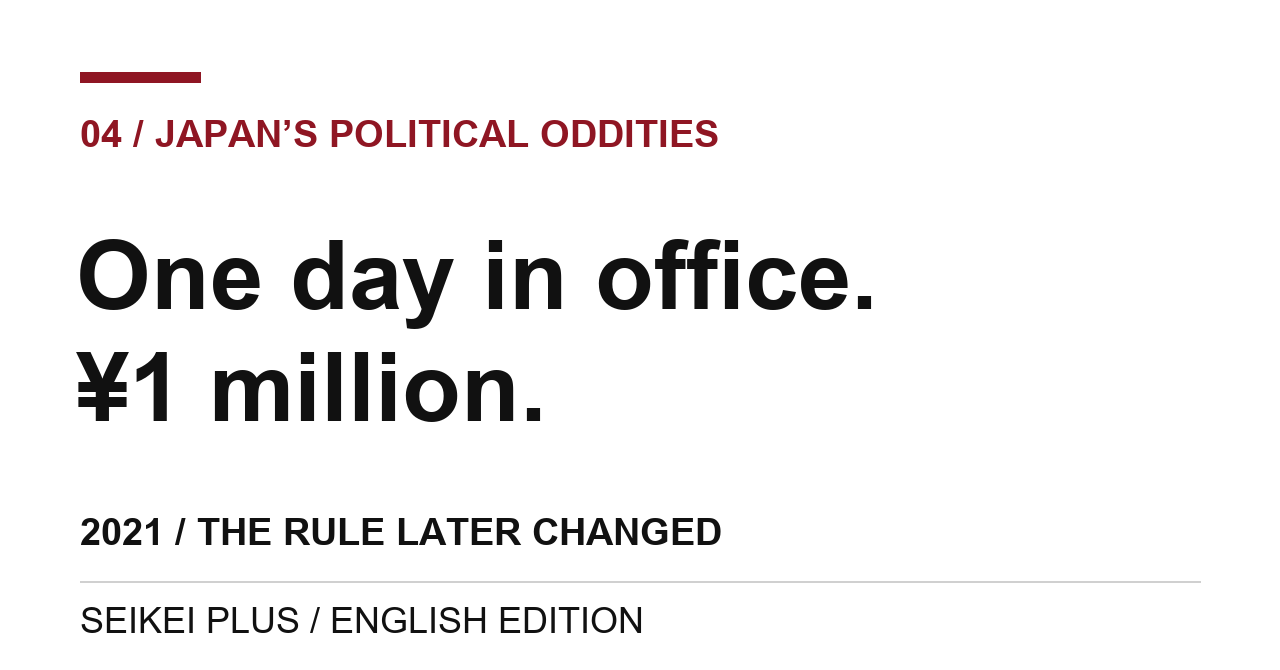
One day of parliamentary membership in October. A full month’s ¥1 million allowance.
That was the mismatch that drew criticism after Japan’s House of Representatives election on October 31, 2021. For members whose October service consisted of that final day, the monthly payment was made in full. In a December parliamentary hearing, Prime Minister Fumio Kishida acknowledged that public doubts about the arrangement were understandable. [1]
The payment was separate from lawmakers’ salaries. It was an allowance intended for expenses associated with parliamentary activity. The distinction made the obvious question more pointed: what justified paying the full monthly amount for one day in office?
The calendar made the problem visible
Japan’s national parliament is called the Diet. The 2021 controversy concerned a benefit for its members, rather than elected officials everywhere in Japan.
The election’s position at the very end of October made the rule easy to explain. A monthly calculation produced the full payment despite the extremely short period of membership that month.
The money was known as bunsho tsūshin kōtsū taizaihi: roughly, an allowance for documents, communication, transport, and accommodation. The cumbersome name was often shortened in Japanese to buntsūhi.
In the December 14 hearing, opposition lawmaker Seiji Osaka also raised the absence of required spending disclosure and attached receipts. The debate therefore concerned both the amount paid and the public’s ability to see what it funded. [1]
There is a useful distinction here. The extraordinary payment followed the payment rule then in place. The size of the payment alone does not establish that a recipient stole money or committed another offence.
An expense allowance needs an explanation
Lawmakers need resources to investigate policy, communicate with constituents, maintain an office, and perform public duties. Funding those activities can help representatives do their jobs.
An expense allowance nevertheless raises a different accountability question from salary. Salary compensates the person. An allowance presented as funding public activity needs rules connecting the money to that activity.
The later legislation made the purpose explicit: research into national affairs, public communication, exchanges with the public, accommodation, and other parliamentary activities. [2]
Our criticism is about the design of the benefit. A full monthly payment triggered by one day of membership is difficult to reconcile with a time based payment system. And a public purpose becomes difficult to assess when the public cannot inspect how the money was spent.
Those are separate problems. Fixing the calendar calculation cannot, by itself, answer the spending question.
The first reform came in 2022
Parliament passed an amendment in April 2022. It was promulgated and took effect on April 22.
The allowance was renamed chōsa kenkyū kōhō taizaihi, referring to research, public communication, and accommodation. The amendment also introduced a daily calculation, running from the date a person becomes a member to the date their membership ends under the specified circumstances. [2]
This addressed the central payment anomaly behind the 2021 headline. It would be misleading to present the one day, full month episode as an unchanged description of the system in October 2026.
Renaming a benefit also changes how its purpose is described. Whether taxpayers can check that purpose is fulfilled depends on the reporting requirements around it.
Spending disclosure followed in 2025
The House of Councillors records August 1, 2025 as the start of the allowance’s spending disclosure system, following a December 2024 legal amendment and rules agreed in April 2025. [3]
The new rules introduced annual reports and the return of unused balances. They specify permitted expenditure for parliamentary activities and exclude election campaigning expenses. [4]
Under the ordinary annual timetable, members submit reports by May 31 of the following year. Publication is required by November 30 of the submission year. Payments exceeding ¥10,000 require itemized reporting and receipt copies or the prescribed alternative documentation. Receipts for smaller expenditures can also be requested through the disclosure procedure. [4]
The start date therefore did not mean that every payment and receipt instantly appeared online. The design includes a reporting period, deadlines, and a separate process for accessing receipts.
The story has two chapters: an easily understood payment anomaly in 2021, followed by reforms to calculation and transparency at different times. Both belong in the account.
A strange headline brought attention to the allowance. Assessing it now requires looking beyond that headline to the rules for payment, disclosure, and unused public money.
Sources
All sources below are in Japanese.
- House of Representatives Budget Committee, December 14, 2021 — the one day payment and the debate over spending disclosure.
- House of Councillors legislative record — the April 2022 name change, purpose, daily calculation, and commencement date.
- House of Councillors announcement — the spending disclosure system began on August 1, 2025.
- House of Representatives official summary of the disclosure rules — expenditure, reports, receipts, and repayment.
Read the series: Japan’s Political Oddities
Written and verified by Kane (Seikei Plus channel) with ChatGPT.