Japan’s Political Oddities · No. 3
Published October 5, 2026. This article looks back at the 2024 election and the 2025 reform.
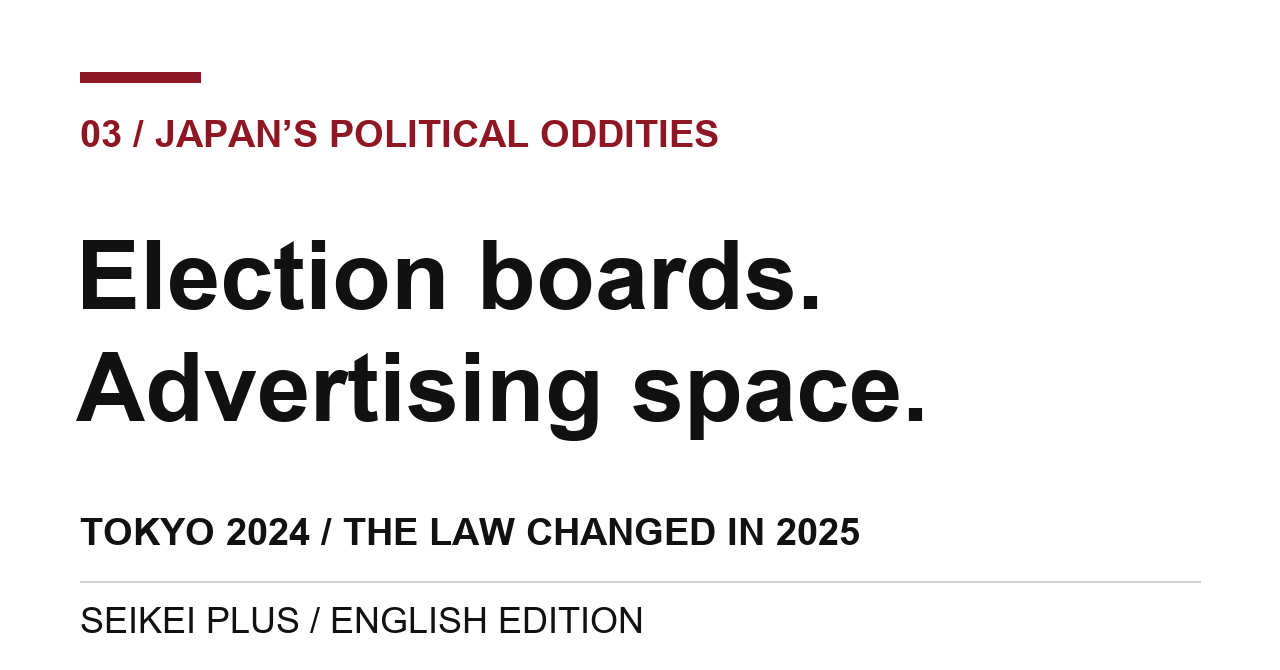
An election poster should help you recognize a candidate. In Tokyo’s 2024 governor election, some posters offered something else: commercial promotions, QR codes leading to business websites, and repeated designs with no candidate’s name, photograph, or policies.
Tokyo’s election administration later described the problem to Japan’s parliament. Display rights had been provided to people other than candidates for payment. A public facility intended to inform voters had become a place for advertising and attention seeking. [1]
A public noticeboard for candidates
During Japanese elections, large boards divided into numbered spaces appear in neighborhoods. Candidates put their posters in the allocated spaces. The boards provide a shared location where voters can see who is standing, including candidates with little money or public recognition.
These are official election facilities, rather than ordinary commercial billboards. Their format also gives each candidacy a visible place in public space. That connection between becoming a candidate and obtaining a poster space was central to the controversy. [2]
The Tokyo election, held on July 7, 2024, attracted 56 candidates. More than 14,000 boards were installed across the capital. Tokyo officials told a parliamentary committee that the number of candidates had exceeded the capacity initially prepared for the boards. [1]
The administrative problem was tangible: officials had to run an election while dealing with more candidates, insufficient spaces, and complaints about what was being displayed.
When the content stopped being about candidates
In February 2025, a Tokyo election official described posters showing adult entertainment businesses, commercial website links, and images or messages that drew complaints about obscenity or attacks on others. Some identical designs occupied multiple spaces. Voters complained about boards near children’s routes to school, among other locations. [1]
The legal gap was surprisingly basic. Before the reform, the election law required details identifying the person responsible for displaying a poster and its printer. It did not directly prescribe its general content in the way many people might assume. [2]
That did not make every imaginable poster lawful. Rules against false statements and provisions in other laws could still apply. “There was no specific rule covering this use” and “anything was permitted” are different claims.
The episode exposed a design problem: a system built around candidates competing for votes could also attract people interested in the visibility of the board itself.
The rules changed in May 2025
Parliament passed a reform in March 2025. It was promulgated on April 2 and took effect on May 2, applying to elections officially announced on or after that date. [4]
The reform introduced three main changes for posters on the official boards. The candidate’s name must be displayed so voters can easily see it. Candidates must avoid content that undermines a poster’s dignity, including harmful attacks on others’ reputations, material contrary to public morals, and commercial promotion. Advertising specific products or otherwise promoting a business on the boards can attract a fine of up to ¥1 million. [4]
Those provisions do not all have the same enforcement mechanism.
During debate, the bill’s sponsors explained that the name and dignity obligations did not give election commissions a general new power to judge political content and order its removal. The specific commercial advertising prohibition carried a penalty. Existing criminal laws remained relevant where conduct fell within them. [3]
This distinction matters. Describing the reform as a blanket power to remove any offensive poster would misstate what parliament enacted.
A reform with a difficult boundary
The problem was easy to see. A voter looking for candidates could instead encounter an advertisement unrelated to choosing a governor.
The solution was harder to draw. Giving officials broad discretion over political messages could also affect legitimate criticism. Parliamentary debate explicitly addressed that tension between preventing abuse of public boards and protecting freedom of political expression. [3]
For our part, the revealing feature is how mundane the entry point was: a numbered rectangle on a public noticeboard. The 2024 controversy forced lawmakers to spell out that the rectangle should identify a candidate, and that it should not be used to promote a business.
Sources
All sources below are in Japanese.
- House of Representatives committee hearing, February 20, 2025 — Tokyo election officials’ account of the 2024 election and poster problems.
- House of Councillors research paper, July 14, 2025 — the poster system, earlier rules, and the 2025 amendment.
- House of Representatives committee debate, February 25, 2025 — enforcement and freedom of expression.
- House of Councillors legislative record — the 2025 poster amendment and its commencement provisions.
Read the series: Japan’s Political Oddities
Written and verified by Kane (Seikei Plus channel) with ChatGPT.