Japan’s Political Oddities · 05
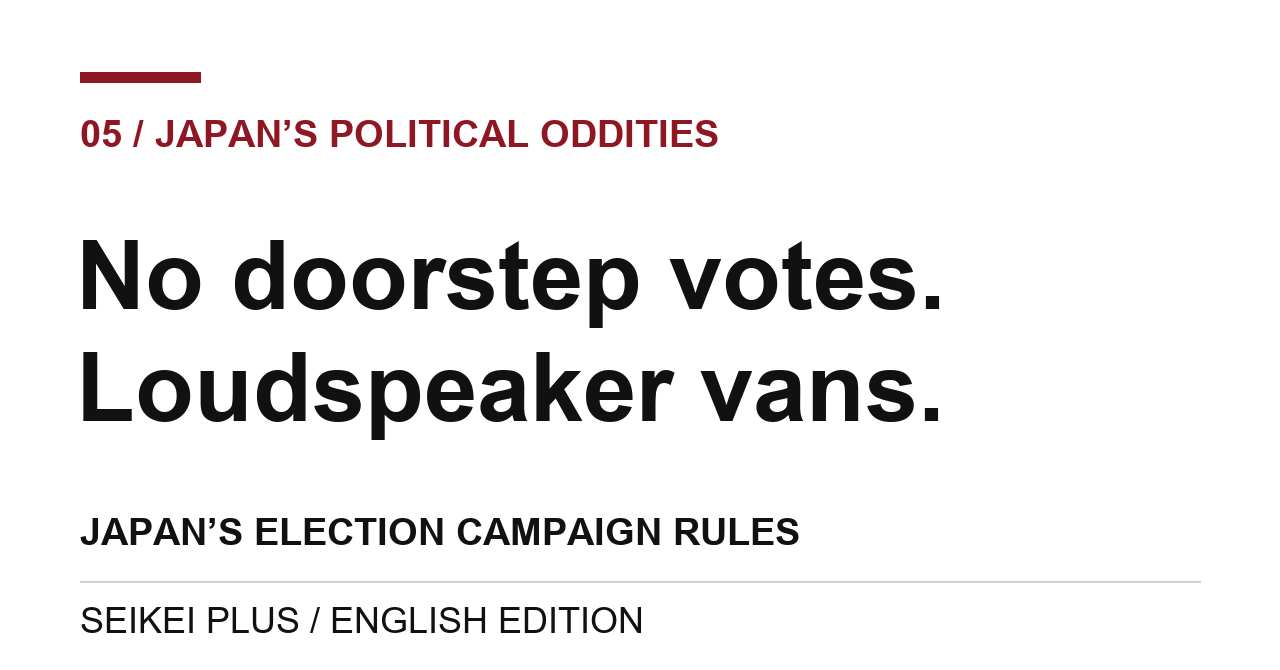
A campaign van can travel through a Japanese neighborhood repeating a candidate’s name through loudspeakers. Yet visiting homes one by one to ask residents to vote for that candidate is prohibited.
Japan’s election rules permit the broadcast but prohibit door-to-door vote solicitation. Official guidance draws that line by the purpose and method of campaigning. That explains the election soundscape that can puzzle residents and visitors alike.
What the doorstep rule prohibits
The Tokyo election commission explains that nobody may visit homes, offices or shops individually for the purpose of asking people to vote for a particular candidate. Its guidance also covers going door to door to announce campaign speeches or repeat candidate or party names.
The rule applies to campaign methods, rather than every discussion about politics. Tokyo’s guidance distinguishes activities aimed at securing votes for a particular candidate in a particular election from political activity more generally. It also says formal election campaigning runs from the filing of a candidacy on the official opening day until the day before polling.
The restriction applies to polite and unpaid campaigners too. What matters is whether they visit individual premises to solicit votes.
Other face-to-face appeals are possible. Kobe City’s election FAQ says a candidate may ask for a vote when they happen to meet an elector. It distinguishes this individual encounter from repeated loud calls for votes, which have their own restrictions.
Why the vans can keep calling
The rules expressly allow certain uses of campaign vehicles. Yamaguchi Prefecture’s election commission says repeated calls from an election vehicle may take place during the campaign period between 8 a.m. and 8 p.m.
There are obligations around sensitive locations. The same guidance says campaigners must try to maintain quiet near schools, hospitals, clinics and other medical facilities, citing Articles 140-2 and 141 of the Public Offices Election Act.
Campaigns must follow those limits on time and conduct even when loudspeaker use is permitted.
Yokohama’s Kohoku Ward addresses the resulting noise directly in its public FAQ. It explains that vehicle loudspeakers and amplified street speeches are legally recognized campaign methods, and that there is no specific volume restriction for those activities under the campaign rules it describes. The ward asks residents for understanding during elections.
That official response helps explain why a complaint about noise may receive an explanation of election law rather than an instruction to stop the vehicle.
What this tells us about campaigning
The loudspeaker and doorstep rules offer a useful way to examine the balance between reaching voters and protecting their daily lives. A broadcast may reach people who never chose to listen. A doorstep conversation may allow a voter to ask a question, but also creates direct pressure to respond.
These choices give campaigns an incentive to use the channels the law permits. Whether repeated names persuade voters, and whether voters welcome the noise, are separate questions. Answering them requires evidence about campaign effectiveness and voter preferences.
For readers encountering a Japanese campaign van, the important point is practical: the repeated announcements are part of a regulated campaign system. The same system draws a firm line around door-to-door vote solicitation, even though it permits other personal encounters and public appeals.
Our question is whether these rules give voters enough opportunity to question candidates while keeping unwanted intrusion within reasonable limits.
Sources
All sources below are official election guidance in Japanese, checked on 5 October 2026.
- Tokyo Metropolitan Election Administration Commission: campaigning and political activity
- Yamaguchi Prefecture: restrictions on repeated calls from election vehicles
- Yokohama, Kohoku Ward: complaints about election vehicles and street speeches
- Kobe City: requesting a vote during a chance encounter
Read the series: Japan’s Political Oddities
Written and verified by Kane (Seikei Plus channel) with ChatGPT.